Article
Biotech outperforming the market. ABGSC’s equity analyst Viktor Sundberg explains the trend
Insights
Research

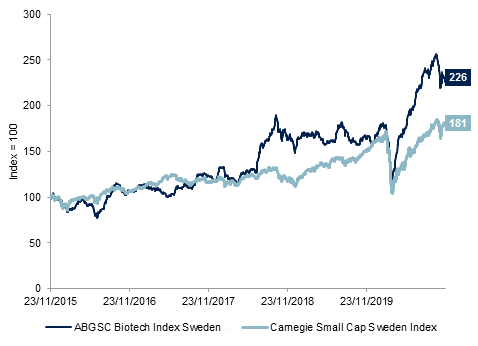
For long-term investors, biotech has proved to be a good investment. Over the last five years, ABGSC’s equally-weighted Biotech Index Sweden has significantly outperformed other Swedish small caps.
According to ABG Sundal Collier’s healthcare analyst Viktor Sundberg, the biotech sector has outperformed the market in Sweden due to the fact that several biotech companies have entered the late stages of their development, with successful clinical studies. We have also had a couple of companies being acquired, such as Wilson Therapeutics, Nuevolution and Cormorant Pharmaceuticals.
“When you see so many companies succeeding in their trial processes, it fuels interest from the market, and more investors are willing to invest. That creates a positive upward spiral and strengthens the ecosystem”, says Viktor Sundberg.
In March this year, biotech related share prices dropped sharply along with the rest of the stock market, due to the COVID-19 pandemic. However, the V-shaped recovery was much steeper for the biotech sector. Viktor Sundberg believes that the strong recovery can be attributed to biotech having drugs that could possibly be used for COVID-19 patients, as well as some clinical trials reading out positively.
The Biotech Index deviated sharply from a commonly used small cap index already in 2018. The reason at that time was the successful phase-2b trials from a single company – Bioarctic (the share price increased by almost 500 per cent during the summer of 2018).
“The fact that a single company can shift the index performance so much makes it very interesting to follow the industry, but also harder to predict the long-term performance for the sector in general. It really shows that you need a deep understanding and knowledge on the company level, as well as on the sector level”, says Viktor Sundberg.
Although it is often hard to predict the outcome of clinical trials for single companies, Viktor Sundberg believes that biotech investments in general qualify for any diversified portfolio. One long-term megatrend driving the sector is the world’s aging population, which is increasing the need for medical treatments and drugs.
“And it’s not just about an aging population, it’s also former third-world countries becoming richer and more developed in terms of social and healthcare systems. We firmly believe that these countries will spend more money per-capita on healthcare going forward”, he explains.
“Furthermore, the bigger pharmaceutical companies have cut down on their internal R&D and are relying more on smaller biotechs to do the earlier clinical trials. The larger companies then acquire the smaller ones, or partner with them when positive data is reading out, further fuelling the returns for smaller biotechs. For example, only 11 per cent and 23 per cent of Johnson & Johnson’s and Pfizer’s leading products were developed internally: the rest originated from smaller biotechs”, according to Viktor Sundberg.
Among the best biotech performers on the stock market this year are Kancera and Intervacc (First North). By the end of October, their share prices had risen by 484 per cent and 144 per cent, respectively. On the Nasdaq main list, Hansa Biopharma and Cantargia stand out as the best performers, with their share prices climbing by 183 and 172 percent, respectively by the end of October.
Viktor Sundberg believes that the Swedish biotech sector stands out from a European perspective.
“Nowhere else in Europe do we see so many biotech companies in relation to the size of the economy, and also so many of them listed on the stock market. One reason is that researchers in Sweden often own the research, not the universities. This makes it easier to commercialise the research and to start companies. The investment culture in Sweden has a long history of stock market investments from both institutions and the public, combined with a lack of private-equity investors focusing on the biotech sector, which makes Sweden uniquely well-adapted for biotech listings”.
Although there are several listed biotech companies in Sweden, new company listings in the country have declined over the last couple of years. While seven biotech companies were listed in 2016, only one (Stayble Therapeutics), was listed in 2020.
Viktor Sundberg does not believe this should be seen as a sign of decreasing interest from the stock market.
“What we saw in 2016 was simply the result of several companies coincidentally going public at the same time. As long as the market in general stays afloat, I believe that we will see more biotech companies being listed in coming years”, he says.
ABGSC clients can find all our latest research at research portal.
ABGSC Biotech Index YTD (Source: Factset)